EDISWAN made in England.
NOS Loctal, TEFLON Socket. Silver plated contacts. Made by Ediswan, England. Originally packed in pair boxes, or single in sealed military boxes. Pricing is for one single socket.
Dimensions drawing
Together with the adjustable (!) socket dampers, this results in a very nice combination. The sockets contacts are silver plated. The solder contacts are tin plated.
Picture2 - Picture3
Loctal TEFLON socket NOS.
Order Number:
398-803-99
 We designed this air ventilation plate specifically for the Ediswan sockets. Beneath the black paint, there’s a copper screen electrically connected to the tube base and mounting screws. While optional, we strongly recommend connecting a wire from the center pin to the tube socket screw for optimal shielding. This setup, combined with the metal base of LOCTAL tubes, provides excellent protection against stray hum—something you can't achieve with Octal sockets!
With steel tubes, the whole tube outside case becomes connected to this, which works even better. This center pin has an electrical connection at the loctal socket!
If isolating mounting devices like rubber distance holders are used, we recommend connecting one of the socket screws to the amplifier chassis with a wire to maintain proper shielding.
EE80-27mm base plate. Order nr: 321-027-17
Dimensions and material:
- Black plate outside: 59 x 59mm
- Mounting holes, center distance 48mm.
- Mounting holes of socket, center distance 38mm
- Glass fiber Epoxy, black painted
- All round holes have gold plated sides.
- Two optional LEDs mounted. If you don't want these, they can easily be removed, and their holes look like normal ventilation holes.
Link to EE80 ventilation adapter
BIG WARNING FOR CHINESE LOCTAL SOCKETS
These Chinese Loctal look nice, and are cheap. So it is understandable, manufacturers and DIY use them. But... they are a terrible hack, and damage your tubes. .
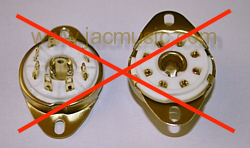
WARNING: There are MANY times problems with those, because the construction is simply wrong. I am not interested what the Chinese are selling, but problems arise when DIY and manufacturers use these LOCTAL sockets together with NOS tubes bough from us. And then complain, about "broken tubes". This wrong conclusion, I understand it. It comes quickly, after the old tubes still work well, while the new bought tubes die after very short time. However: Chinese Loctal sockets are the #1 tube destructors. They have a risk to crack the glass along the pins, which causes a vacuum problem after short use.
We say DO NOT use Chinese Loctal sockets for our tubes, and if you do, it is entirely on your own risk. Also we can make no exceptions for extremely expensive OEM amplifiers, finally just cracking the glass along the pins.
Here is what causes it
1) The Center contact.
All vintage constructions use some kind of Spring-like material. Or a shaft with a small circular spring around it. The Chinese did not bother, they just formed a stiff piece of none-spring metal this way, and call it a center contact. The shape of this piece differs from socket to socket. Some are really bad made. But even those which look optically good, need EXTREME FORCE to put a tube in for the first time. It is only after plugging and unplugging a tube many times, the contact begins too loosen somewhat, but then the damage may already have been done. The tube had to be pressed in with excessive force multiple times, and worse even the unplugging works only by wiggling the tube out with force. So, under an angle, but if there is one thing you should not do with Loctal tube pins, it is put side force on them. Reason is, they CAN NOT BEND. They are made of hard metal, and the socket is hard glass. Technically ideal, but they do crack the glass if you put side force on it.
2) The shape of the pin holes.
 They used the contacts are from noval sockets, while holes they are in, are too large. This works most if the time, just not always, especially not, when you rotate the tube, like a drill, trying ti get the center pin inside. This is normal to do by itself, but these sockets are constructed too clumsy and sometimes, a tube pin slips between the contact and the ceramic. You you won't notice that, because you need excessive force to press the tube in. Even so, when it happens, the electrical contact is still good. But now the pin sees heavy side force, and will develop a vacuum leak.
What will customer do, who bought perhaps six tubes, and one is not working? The same as everybody, they put another one of the remaining five in, and also swap the tubes in other sockets. Probably damaging one more. So logically, the customer sends all six tubes back, because he thinks all of them are from a bad lot.
3) No movement of the pin is possible
A problem comes also with these sockets while taking them out. The failure construction with the guide pin makes it already hard to insert the tube, but getting it out is even harder. You will be tempted to lift the tube up with a screw driver. Forceful wiggling will try to bend the pins, but this is impossible, because these are hard metal pins. (Unlike Noval tubes which have soft metal pins). Hard metal will not bend, it is hard as steel. But it will crack the glass.
 This pin bending is not possible with vintage sockets, because these sockets are designed to give the pins movement in all directions. (see this drawing). I never thought this was important, until we sold many Loctal tubes like C3g and C3m. Specially with the Telefunken C3g-S which cost more than 250 Euro for one, this is not worth it to save on the sockets, and risk the tube.
Contacts are constructed in such a way, side force is avoided. You can see this with the Ediswan Teflon sockets we sell, but any of the vintage sockets you find, have the same construction. You can easily pull the tube out without violence. And even if you do wiggle, the contacts allow movement in all directions, which is vertical, rotational, and sideways. So no stress will be on the glass.
Chinese Loctal sockets however, fully disrespect all of this. They hold the pins in a tight grip. After several movements, this may cause glass cracks.
Most of the Chinese sockets are fine, just not the Chinese LOCTAL. If you insist on new production, we recommend the Italian JAKEBAND sockets. Yamamoto can be used as well, their Yamamoto noval and loctal do not allow too many plugging or unplugging.
We have large stock of vintage TEFLON sockets by EDISWAN ENGLAND for a very reasonable price. We say this about our own products, but frankly, these are the better than any new made socket, lower prirced, and most recommended. |
 Ber very careful with the Chinese new made Au-8 sockets, see next chapter below here. We recommend not to use Yamamoto for those, as in the Yamamoto Au-8, and tube can get stuck, and you won't be able to get them out any more. .
8-Pin Au Socket for AD1, AZ1, AZ4, etc.
Bakelite socket, black material. We purchased this NOS lot of approximately 800 pieces in 1985, long before Chinese production began.
WARNING: Be cautious of the attractive gold-plated Chinese sockets on Ebay. While they may look nicer than NOS, their dimensions have too much variation. The contacts are not made from beryllium spring bronze, which causes them to deform over time. As the contacts loosen, they can even fall inside the socket. A loose grid contact can ruin a tube, and a loose plate contact can damage the output transformer at the DC current interruption.
Forget about the "gold"—it's fake anyway—better stick with genuine NOS sockets, like the ones we offer here.
|